

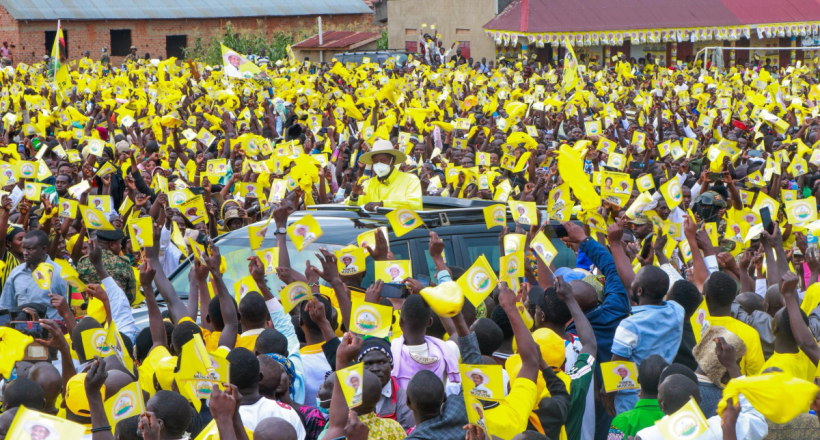
KIKUUBE; President Yoweri Kaguta Museveni on Saturday used his campaign rally in Kikuube District to strongly rally fishing communities to embrace responsible fishing methods as the only sustainable way of protecting livelihoods on Lake Albert.
Addressing thousands of supporters at Kiziranfumbi Primary School Playground, the President placed fisheries management at the centre of his message, warning that bad fishing practices were destroying fish stocks and threatening the future of communities that depend on the lake.
“The issue about the fisheries is first of all to stop bad fishing catching young fish and secondly attacking the fish breeding parts of the lake,” President Museveni said.
“You have to stop catching young fish and also don’t go to fish breeding areas.”
The President acknowledged complaints from fishermen about alleged harassment by security forces enforcing fisheries regulations, which were earlier raised by Speaker of Parliament and NRM Second National Vice Chairperson, Rt. Hon. Anita Among. She told the rally that local leaders had appealed for the President’s intervention over the conduct of enforcement teams on Lake Albert.
Responding, President Museveni defended regulation as unavoidable but emphasised that enforcement must be fair, consultative and guided by local realities.
“Even if you’re fishing well, there must be a limit to the number who are allowed to fish in the lake,” he said, likening the lake to a public facility that must be protected from congestion and misuse.
“Not everybody who wants to enter can be allowed, otherwise the resource will be destroyed.”
Kikuube District, which lies along Lake Albert, relies heavily on fishing for employment, food security and cross-border trade with the Democratic Republic of the Congo.
The President said safeguarding the lake was therefore a matter of survival, not punishment.
He further anchored his argument in indigenous conservation knowledge, insisting that responsible fishing was deeply rooted in African tradition.
“There are elders and clans who know that when you catch a young fish, you put it back,” he said, citing fishing communities in Pakwach and Buliisa.
“They understood long ago that if you eat the young fish, tomorrow there will be nothing.”
Drawing a cultural parallel, President Museveni added: “Even me, a cattle keeper, I don’t eat calves. It is taboo. In the same way, it is not logical to catch and eat immature fish.”
The President reiterated that the deployment of the UPDF Fisheries Protection Unit in 2017 was meant to rescue depleted fish stocks, not to victimise communities, and pledged continued dialogue with elders and leaders to guide sustainable use of the lake.
To reduce pressure on Lake Albert, Museveni urged lakeshore communities to adopt commercial fish farming as an alternative source of income. He cited his own model fishponds and integrated farming projects as proof that aquaculture can generate high returns without destroying natural water bodies.
“Fish farming can give you more money than fighting on the lake,” he said, adding that consultations would help determine who should fish on the lake and how surplus labour can be redirected into aquaculture.
While he also highlighted peace, development and wealth creation under the NRM, the President returned repeatedly to the fisheries question, stressing that protecting Lake Albert through good fishing methods was essential for the long-term prosperity of Kikuube.
“If we destroy the lake, we destroy ourselves,” President Museveni warned, urging fishermen to work with government to preserve the resource for future generations.
Related Posts:


Recommended for you





Leave a Reply
Leave a Reply