

KAMPALA ;The Government of Uganda, through National Water and Sewerage Corporation (NWSC), has launched a Shs694 billion (€145 million) project to supply water from Lake Victoria to more than 1 million people in the fast-growing areas south and west of Kampala, where many households currently receive water only on rationed days.
The Wakiso West Water and Sanitation Project, funded by Impact Fund Denmark (IFDK) through the Government of Uganda, will involve the construction of a major water treatment plant at Bwerenga on the shores of Lake Victoria, with a capacity to process 62,500 cubic metres of water daily.
“We want to ensure that communities in these rapidly growing areas have access to reliable and safe water, while also addressing the sanitation challenges that threaten public health and the environment,” Mugisha said.
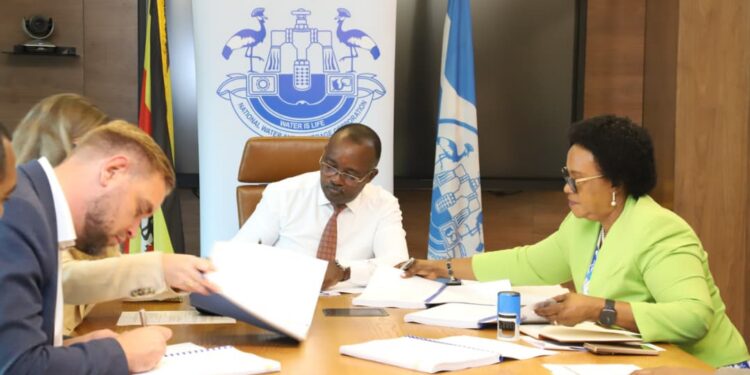
NWSC on Tuesday signed a consultancy services contract worth €9.48 million and Shs2.15 billion with NIRAS A/S, in a joint venture with Fichtner GmbH & Co. KG, to provide consultancy services for the project.
The consultancy team will also include local sub-consultants M&E Associates Ltd and Alliance Consultants Ltd.
The project will cover Kiringente, Mpigi Town Council, Kajjansi Town Council, Kasanje, Kyengera Town Council and Wakiso Town Council, as well as surrounding communities.
According to NWSC, the infrastructure will include a raw water intake, transmission and distribution networks, five service reservoirs with a combined storage capacity exceeding 15,250 cubic metres and pumping stations in Buloba, Katende, Maya and Ssekiwunga.
An estimated 160,000 people living in informal settlements are among the targeted beneficiaries.
To improve access in underserved communities, NWSC plans to establish 941 Community Water Dispensers across the project area.
The targeted locations include Kimbejja, Katereke, Kisozi/Kitemu, Nsangi, Kasenge, Kikajjo, Bweya, Kitende, Namulanda, Nkungulutale, Kafumu, Kikonkoma, Lwanga, Bumoozi, Kakoola, Kavule, Maziba, Ssisa and Wamala.
Beyond water supply, the project will address poor sanitation through the construction of a decentralised faecal sludge treatment plant at Kajjansi, with a capacity of at least 400 cubic metres per day.
The facility is expected to reduce indiscriminate disposal of faecal sludge, which contaminates surface and groundwater sources and exposes communities to public health risks.
The consultancy contract will be implemented in two phases.
The first phase, lasting 20 months, will involve preparing detailed engineering designs, technical specifications and bidding documents for the construction works.
The second phase will involve supervising construction, commissioning completed facilities and overseeing the defects liability period.
Construction is expected to take 30 months, followed by a 12-month defects liability period, bringing the second phase to 42 months.
The project is expected to strengthen water and sanitation services in communities west of Kampala, where rapid urbanisation and population growth have placed increasing pressure on existing infrastructure.
Related Posts:



Recommended for you




Leave a Reply
Leave a Reply